
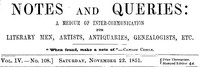
Notes and Queries, Vol. IV, Number 108, November 22, 1851 by Various
Let's clear something up first: this isn't a book with a plot in the traditional sense. Notes and Queries was a weekly periodical, a kind of public forum for the intellectually curious. This specific issue, from November 1851, is a single snapshot of that ongoing conversation.
The Story
There is no central narrative. Instead, you open the pages and find yourself in the middle of dozens of tiny mysteries and debates. One contributor asks for help identifying an obscure medieval manuscript fragment. Another provides a detailed answer about the history of a specific folk custom in Cornwall. A third writes a short note correcting a previously published fact about Roman coins. It's a chaotic, wonderful mix of the profound and the trivial, all treated with equal seriousness. You see knowledge being built, piece by piece, through collaboration and polite debate. It's the slow, pre-digital process of crowd-sourcing answers to life's random puzzles.
Why You Should Read It
I loved this because it completely humanizes the past. History can feel like a list of dates and dead kings, but here you meet the people. You feel their passions, their obsessions over seemingly small details. It’s incredibly grounding. The gentleman earnestly researching provincial dialects is just like a modern Reddit user deep in a niche hobby forum. The person seeking the origin of a family saying is on the same quest we go on today with ancestry websites. It shows that the drive to connect, to share knowledge, and to simply figure things out hasn't changed a bit, even if our tools have. The writing style is formal but often charming, and you get a real sense of community from these pages.
Final Verdict
This is perfect for history buffs who want to see the past unvarnished, not through a historian's later analysis. It's also great for anyone fascinated by how people share information. If you enjoy browsing Wikipedia rabbit holes or listening to podcasts about everyday history, you'll feel right at home here. It's not a cover-to-cover read; it's a book to dip into, to marvel at a few entries at a time. A word of caution: it's very much a primary source, so it requires a bit of patience. But if you give it that, you'll be rewarded with one of the most authentic glimpses into the Victorian mind you're ever likely to find.
Michael Sanchez
1 year agoRead this on my tablet, looks great.
Kenneth Flores
1 year agoI was skeptical at first, but the emotional weight of the story is balanced perfectly. I couldn't put it down.
Jennifer Ramirez
9 months agoI didn't expect much, but the arguments are well-supported by credible references. A true masterpiece.






Melissa Young
1 year agoIf you enjoy this genre, it challenges the reader's perspective in an intellectual way. I will read more from this author.