
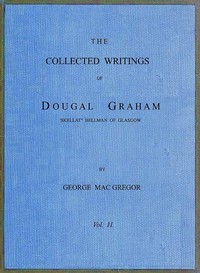
The Collected Writings of Dougal Graham, "Skellat" Bellman of Glasgow, Vol.…
So, what's this book actually about? It's not a novel with a single plot. Think of it as a scrapbook of 18th-century life, assembled by its most charismatic town crier. Dougal Graham was the 'Skellat' Bellman of Glasgow—'skellat' roughly means someone who makes a racket. His job was to walk the streets, ringing a bell and announcing the news. But Graham was a showman and a poet. He didn't just say the news; he turned it into catchy, often hilarious, and sometimes brutally honest verse.
The Story
There is no traditional story here. Instead, you get a front-row seat to decades of Scottish history through Graham's eyes. He covers the big events, like the Jacobite Rising of 1745, writing from the perspective of the common people caught in the chaos. But the real gold is in the smaller stuff: poems about a disastrous local play, satires on crooked politicians, bawdy tales of love and mischief, and advertisements for everything from lost dogs to public executions. This collection is his life's work, a chaotic and brilliant record of what people laughed at, feared, and argued about.
Why You Should Read It
Reading this feels like listening in on history. Textbooks give you dates and treaties; Dougal Graham gives you the smell of the street, the sound of the crowd, and the gritty humor people used to cope. His voice is unforgettable—clever, observant, and completely unpretentious. You get a real sense of the man: a sharp-witted survivor using his rhymes to navigate a hard world. The language is old Scots, which can be a challenge, but it's also what makes it so authentic and lively. It pushes you to read aloud, to hear the rhythm he intended. It’s history with the mud still on its boots.
Final Verdict
This isn't for everyone. If you want a neat, linear historical narrative, look elsewhere. But if you're the kind of person who loves primary sources, social history, or Scottish culture, this is a treasure. It's perfect for history buffs who want to go beyond the battlefield, for writers looking for a truly unique voice, and for anyone with Scottish roots curious about their ancestors' daily chatter. It's a demanding, rewarding, and wildly entertaining conversation with the past.
Melissa Williams
3 months agoGreat reference material for my coursework.